About the Department
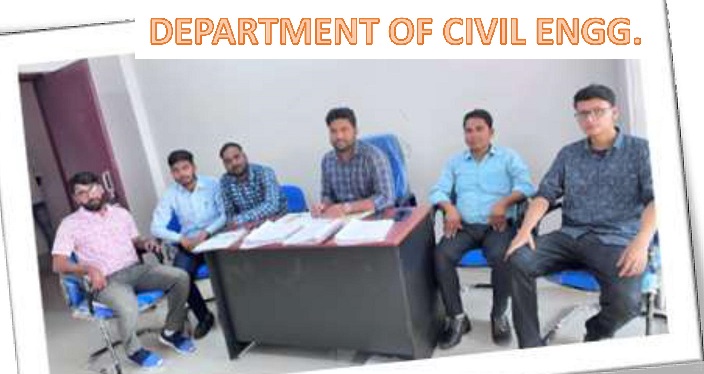
Department of Civil Engineering, since its establishment in 2018 has been at the forefront of teaching in the field of Civil Engineering. Currently, the Department admits 60 candidates for the Under-Graduate programme. In its regular academic programme, the department offers basic Diploma course in Civil Engineering which includes Structural Engineering, Geotechnical Engineering, Transportation Engineering, Water Resources Engineering, Environmental Engineering and Engineering Geology. The course makes the students capable in identifying, formulating and solving civil engineering problems that meets specified performance, cost, time, safety and other quality needs and objectives with professional and ethical responsibility. The laboratories are well equipped with the state of the art instruments. The projects offered are in keeping with the needs of the industry and the recent advancement in the technical field. The Department provides research and consultancy services to various public and private sector organisations, and receives research and modernization grants from DST Bihar, MHRD, and AICTE. The Civil Engineering department has recently been assigned projects of HUDCO in which low cost housing in rural and urban areas are being constructed. One such low cost housing building in the institute funded by HUDCO serves as an example to the public living in rural and urban areas of Araria. The department also serves as a state technical agency to the ministry of rural development, Government of India.
Specializations
Sub-fields of Civil Engineering
Civil Engineers should be familiar with the following techniques and tools:
Objectives
Program Educational Objectives (PEOs)
Graduates will be able to design, analyse and mathematically model civil engineering projects, contributing to sustainable infrastructure development.
Graduates will engage academia, industry, and government organizations, applying their technical knowledge to foster effective professional collaborations.
Graduates will pursue lifelong learning, participate in professional and multicultural networks, contribute to the advancement of civil engineering at national and global levels.
Outcomes
Program Outcomes (POs)
The Program Outcomes (POs) of the Diploma Program are:
Basic and Discipline Specific Knowledge: Apply knowledge of basic mathematics, science, and engineering fundamentals, and an engineering specialization to solve civil engineering problems.
Problem Analysis: Identify and analyze well-defined civil engineering problems using modified standard methods.
Design / Development of Solutions: Design solutions for well-defined technical problems and assist with the design of systems components or processes to meet specified needs.
Engineering Tools, Experiments and Testing: Apply modern engineering tools and appropriate technique to conduct standard tests and measurements.
Engineering Practice for Society, Sustainability, and Environment: Apply appropriate technology in context of society, sustainability, environment and ethical practices.
Project Management: Use engineering management principles individually, as a team member or a leader to manage projects and effectively communicate about well defined engineering activities.
Life Long Learning the Diploma holder of Civil Engineering will be able to: Analyze individual needs and engage in updating in the context of technological changes in the field of Civil Engineering.
Specific Outcomes
Program Specific Outcomes (PSOs)
Students will analyse, design, and innovate civil engineering infrastructure components, demonstrating comprehensive understanding of core principles.
Students will recommend sustainable practices and manage construction resources efficiently, demonstrating a strong understanding of environmental and societal impacts.